

Quick Summary
A first aid kit inspection service in Ontario checks that workplace first aid boxes and their contents meet Ontario Regulation 1101, which requires inspection at least once every quarter-year with each box's inspection card marked. Nepean workplaces can use such a service to keep the schedule and paperwork in order.
- Ontario employers must inspect first aid boxes at least once every quarter-year.
- Each first aid box needs its inspection card marked at every check.
- A new or moved kit should be checked as soon as it is put in place.
- Inspections follow five stages: container, contents, expiry, documentation, and follow-up.
- Keep a master log and retain past entries for at least the current and prior year.
Table of Contents
- What Ontario Law Requires for Workplace First Aid Kits
- How Often a First Aid Kit Inspection Must Happen
- First Aid Kit Inspection Checklist: What to Check at Each Visit
- Keeping a First Aid Kit Inspection Log That Stands Up to an Audit
- Restocking Used and Expired Supplies in a Workplace Kit
- Staff-Led Inspections Versus an Outside Inspection Service in Nepean
- Booking Your First Aid Kit Inspection With First Aid Plus
- Frequently Asked Questions
What Ontario Law Requires for Workplace First Aid Kits
Last Updated: November 17, 2026
Ontario employers must inspect first aid boxes and their contents at least once every quarter-year, and must mark the inspection card for each box. That requirement comes from Ontario Regulation 1101 First Aid Requirements, the province's official first aid regulation. For a Nepean workplace, a first aid kit inspection service in Ontario is one way to keep that schedule and the paperwork in order.
Regulation 1101 sets the baseline. It covers the required contents of a first aid box, the first aid station, and the training that workers need to respond to injuries. Employers who fall short often do so on routine checks rather than on the initial purchase.
The Workplace Safety and Insurance Board also maintains guidance on the program. Its WSIB guide to Regulation 1101 first aid requirements notes that the First Aid Program was updated in 2026, including changes to certificate names. Check the current version before you rely on any older binder or checklist.
Employers should keep three things on hand:
- A copy of the current regulation
- The inspection card for each box
- A record of who completed each inspection and when
How Often a First Aid Kit Inspection Must Happen
The regulation sets the inspection interval at least once every quarter-year, which is roughly every three months. Inspections are not a one-time event at setup. They repeat for as long as the kit stays in service.
That keeps the task predictable and makes missed checks easy to spot. Mark the date on the inspection card and set a calendar reminder for the next one.
A new kit or a kit that has been moved should be checked as soon as it is in place. Waiting for the next quarterly date leaves a gap during which missing items could go unnoticed.
Watch out: a card that is not dated or signed looks the same as a card for an inspection that never happened. Record every check on the day it is done.
The regulation sets a clear rhythm for these checks, which the article summarises below.
| Requirement | Value | Note |
|---|---|---|
| Inspection interval | At least once every quarter-year | Roughly every three months |
| Inspection card | Marked for each box | Record every check on the day it is done |
| New or moved kit | Check as soon as it is in place | Do not wait for the next quarterly date |
First Aid Kit Inspection Checklist: What to Check at Each Visit
A professional inspection visit is more than a glance inside the box. Most practitioners structure the visit in five stages: condition, contents, expiry, documentation, and follow-up. Working through them in order keeps the check consistent from one quarter to the next and produces a record that stands up to scrutiny.

Stage 1, Container and location. Confirm the box is intact, the lid closes and latches, and the box is mounted or stored where the workplace plan says it should be. Check that the box is visible and reachable, not buried behind stock or locked in a cabinet nobody can open during an emergency. If the kit is mounted, confirm the fasteners are secure. If it is portable, confirm it is returned to its designated spot after each use.
Stage 2, Contents against the required list. Count each item against the contents list for the kit type and worker count. Regulation 1101 sets out the required contents for each type of first aid box, and the quantities scale with the number of workers on shift. Check that bandages, dressings, scissors, and other tools are present in the quantities the kit calls for. Note anything missing, damaged, or clearly used.
Stage 3, Expiry and condition. Look at every sterile item and every product with a best-before date. Pull anything past its date. Check packaging for tears, moisture damage, or contamination, and discard anything that is no longer sealed. A common pattern is a kit that passes a quick count but fails on expiry because the dates were never checked.
Stage 4, Documentation. Confirm the inspection card is present, dated, and signed for the current quarter. Check that the log entry matches what was actually found. If the card is missing or the last entry is undated, treat that as a finding, not a formality.
Stage 5, Follow-up. Record what was missing or expired, what was replaced, and when. Schedule the next quarterly check before leaving the site. A visit that finds a problem and documents the fix is more useful than one that records nothing.
A practical checklist for each visit:
- Box is intact, latched, and in its designated location
- All required items are present in the correct quantities for the worker count
- No sterile items or medications are past their expiry date
- Packaging is sealed, undamaged, and dry
- Inspection card is dated and signed for the current quarter
- Missing or expired items are recorded and replaced
- Next quarterly inspection is scheduled
Watch out: a kit can pass a visual check and still fail an audit if the inspection card was signed without the contents actually being counted. Sign only after the count is done.
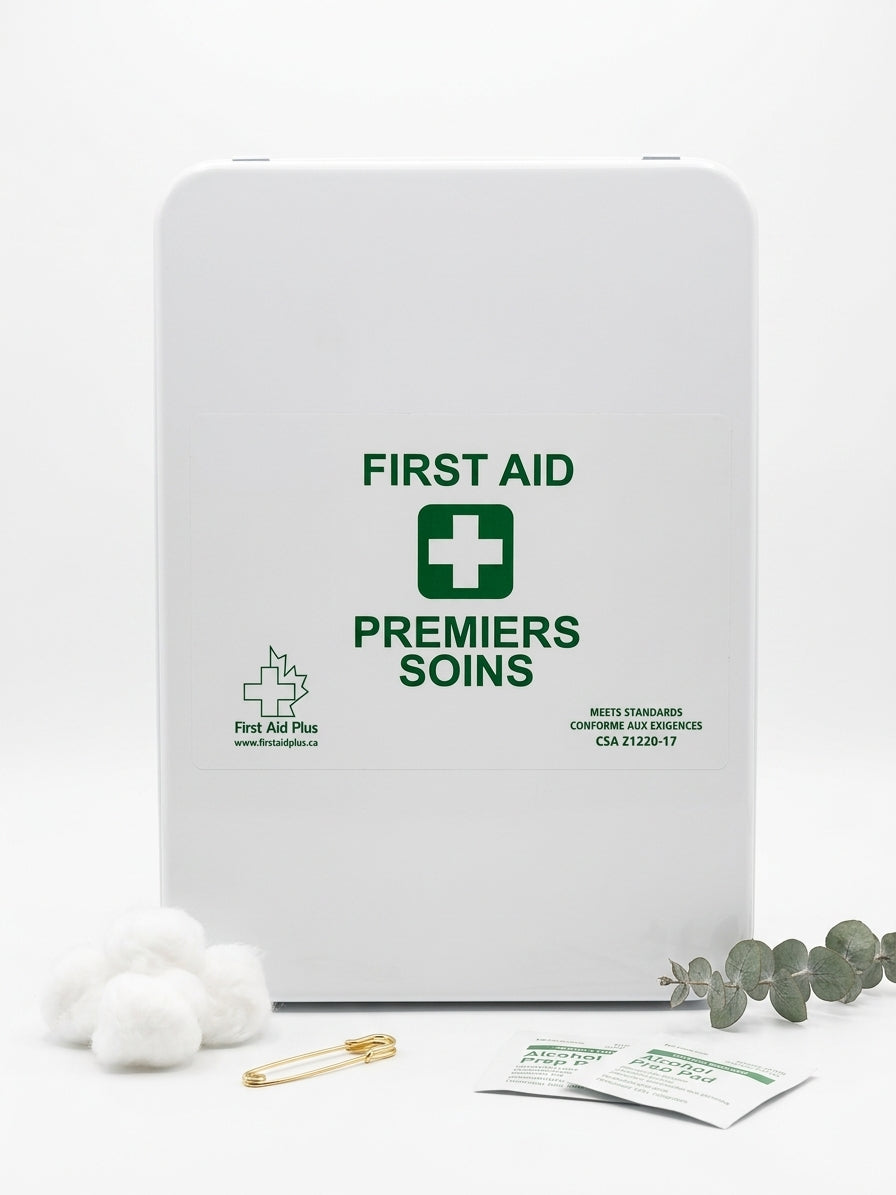
Our First Aid Plus product catalogue listing for CSA-compliant cases page is a useful reference when you need a replacement container. The metal first aid case rated for small workplaces is built to hold a CSA Type 2 Basic kit for 2 to 25 workers.
Keeping a First Aid Kit Inspection Log That Stands Up to an Audit
An inspection log is only useful if it is complete, consistent, and retrievable. Each entry should record the date, the name of the person who completed the check, the box location or identifier, the items found missing or expired, the actions taken, and the date the replacement was made. If a kit serves a specific department, shift, or vehicle, record that identifier too so the entry can be matched to the right box.
A workable log has three parts:
- The inspection card attached to each box, marked at each quarterly check. This is the on-the-spot record.
- A master log kept in a shared folder or binder that the health and safety committee can access. This is the history that shows a consistent pattern of checks across all boxes.
- A restock record that ties each replacement to the inspection that found the gap. This closes the loop between finding a problem and fixing it.
Retain past entries for at least the current year and the prior year so you can show a consistent history of quarterly checks. If an inspector or committee member asks for the record for a specific box, you should be able to produce it without searching through loose paper.
A simple audit-readiness routine:
- Every box has a current inspection card with a dated, signed entry for the most recent quarter
- The master log matches the cards for each box
- Missing or expired items have a recorded replacement date
- The log is stored where the health and safety committee can access it
- Past entries are retained and retrievable
If an item was missing, write down what was done about it and when. A log that shows a problem found and fixed is more credible than one with no entries at all. A common pattern is a log that looks complete until someone asks for the entry for a specific box on a specific date.
Watch out: a log kept only on a clipboard beside one box will not cover a workplace with multiple kits across departments, shifts, or vehicles. Use a master log that lists every box and its location.
Restocking Used and Expired Supplies in a Workplace Kit
Restock as soon as you find an item missing or past its date. Waiting until the next quarterly inspection leaves the kit incomplete in the meantime.
Keep a list of the items each kit should contain, along with the quantity of each. Compare it against the box during each check. Replace used dressings and bandages immediately after an incident, and record the replacement in the log. You can browse workplace first aid kits to restock what is missing.
If a kit is damaged or too small for the number of workers, you may need a new container. The empty metal first aid case for 2 to 25 workers and the portable first aid bag for vehicles and field use are options for different setups.
Staff-Led Inspections Versus an Outside Inspection Service in Nepean
Staff can do the inspection in-house. That option costs little beyond the person's time, and it gives you someone on site who knows the kit.
An outside inspection service adds a second set of eyes. An external provider can check against the current regulation, flag gaps that staff may miss, and produce documentation for an audit.
The right choice depends on how many sites you run and how much internal capacity you have. A single small workplace may manage well with a trained staff member. Multiple locations, or a team without anyone comfortable with the regulation, may benefit from an external check.
Whichever route you take, the staff member doing the inspection needs training. The standard first aid course offered in Ontario builds the knowledge needed to recognise gaps in a kit. The blended standard first aid course option is a flexible way to train staff who have limited time away from the floor.
Booking Your First Aid Kit Inspection With First Aid Plus
Book your first aid kit inspection with First Aid Plus to get a dated, documented check that matches Ontario's quarterly requirement.
Frequently Asked Questions
How often should workplace first aid kits be inspected in Ontario?
Under Ontario Regulation 1101 (First Aid Requirements), employers must inspect first aid boxes and their contents at least once every quarter-year, meaning roughly every 90 days, and mark the inspection card for each box. Many employers set a fixed monthly check as an extra safeguard, but the regulation's minimum is quarterly. Confirm current wording on the official e-Laws or WSIB site before relying on it.
What should be checked during a first aid kit inspection?
A complete inspection confirms that every required item is present in the quantity the regulation requires, that supplies are not expired or damaged, and that the kit is complete and serviceable. The inspector also checks that the box is clean, sealed, and easy to reach, and that the inspection card is filled in and signed. Replacing used or expired items on the same visit keeps the kit compliant until the next check.
Can a first aid kit inspection service help with Ontario workplace compliance?
Outside inspection services can check each kit against Ontario requirements and leave dated records behind. Employers with several sites or limited staff time often find this easier than tracking every box in-house. Staff can still do the inspections themselves if they are trained and keep proper records.
How do I keep a record of first aid kit inspections?
Keep a dated inspection card on or inside each first aid box, showing the date, the inspector's name, and a signature confirming the kit was checked and found complete. A simple inspection log that lists every kit, its location, and each inspection date makes an audit faster. Keep records for every inspection, not only the most recent one, so you can show the quarterly schedule was followed.
